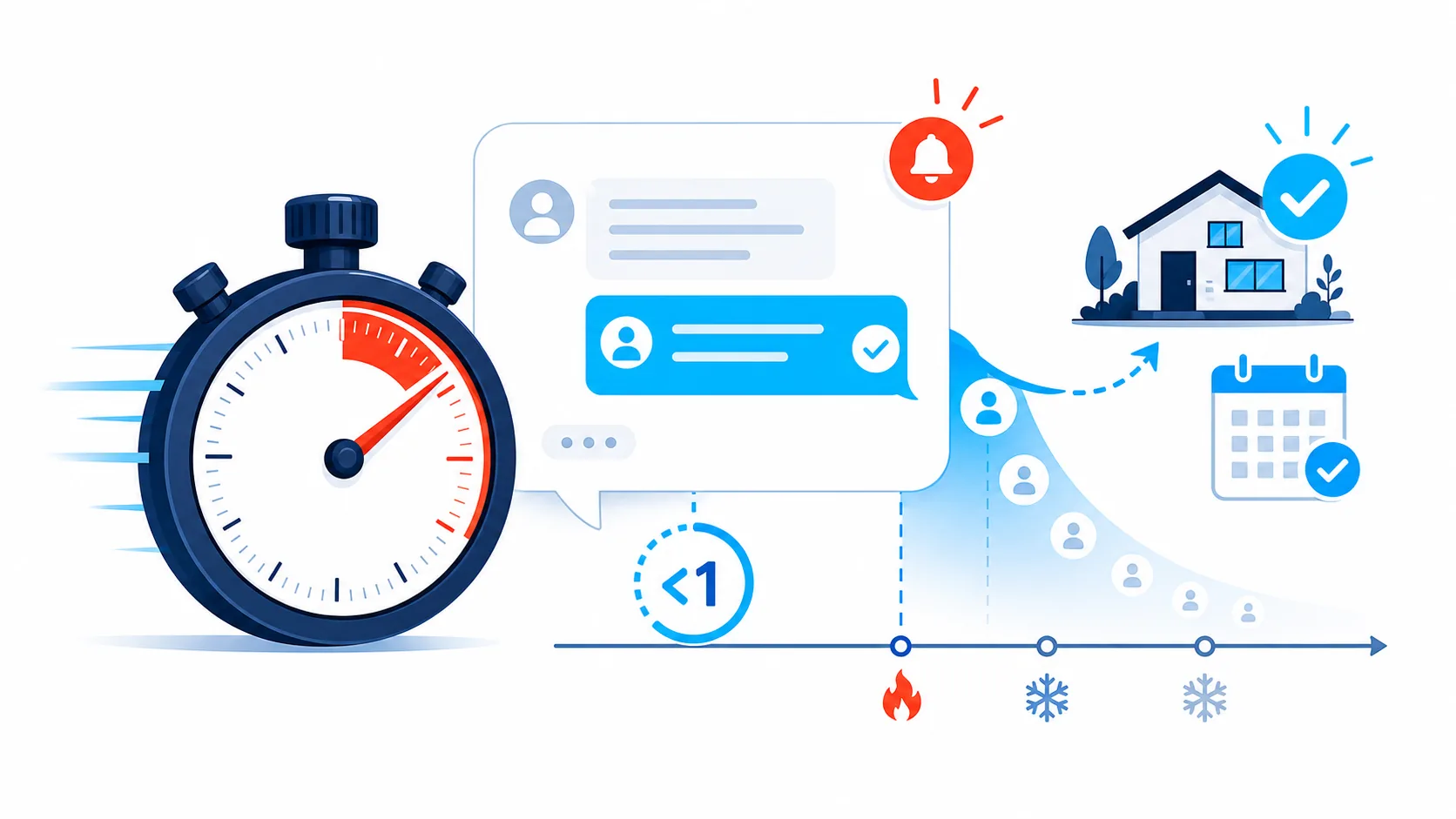
Think about the last time you filled in a quote form. You had your phone in your hand, the problem front of mind, and a few minutes set aside to deal with it. A business that replied while you were still holding the phone had your full attention. A business that replied at 6pm was competing with two other quotes and dinner.
That gap is speed-to-lead: the time between a new enquiry arriving and your first meaningful response. Shorten it and you usually book more work from the same marketing spend, without buying extra traffic or changing what you offer.
For a home improvement business, slow response is one of the largest hidden profit leaks going. You have already paid for the advertising and generated the enquiry. If your first response then takes thirty minutes, you are booking fewer of those leads than you could be, purely because of timing.
Why Speed Decides Who Wins the Job
When someone’s hot water fails, a circuit keeps tripping, or storm damage opens up their roof, they are not weighing options at leisure. They are solving today’s problem. They contact several businesses in a row, and the first one to respond professionally usually wins, regardless of who is technically the “best” option.
You do not need a research library to believe this. An enquiry answered while the person is still on their phone gets a conversation. An enquiry answered half an hour later reaches someone who has already rung your competitor. The widely cited lead-response research first published by the Lead Response Management study reached the same conclusion years ago: the odds of reaching and qualifying a lead fall away sharply as the minutes pass.
There is a modern complication. Most people are now wary of unknown numbers. Scam calls and dodgy texts have made everyone cautious, and carrier scam alerts and sender ID verification push the same way: people want to know who is contacting them before they engage.
So you still call, but you also send a fast, clearly branded SMS that:
- Shows your business name
- Makes sense in context (“We received your hot water enquiry in [area]…”)
- Includes a simple opt-out if you plan to keep messaging
If you change one operational thing this month, make it this: respond in under 60 seconds with a message the lead recognises as your business, even when you cannot speak straight away.
What “Good” Looks Like This Week, Not Someday
A practical speed-to-lead system has three parts.
1. New Enquiries Surface Straight Away
Leads need to reach you immediately, whatever the source:
- Phone calls
- Website forms
- Chat widgets
- Google Business Profile messages
That requires clean call routing, reliable email and SMS alerts, and clear responsibility for who monitors what.
2. A First Response in Under 60 Seconds
Your first response does not need to be perfect. It needs to be prompt, clear, and clearly from your business. For SMS, that means showing your name, sounding conversational, and connecting the message to what the person just did.
3. A Simple Path to Booking
Every fast response should guide the lead toward a specific time slot, a clear callback time, or a simple way to provide the one detail you need. The aim is to make proceeding with you easier than dialling the next business on the list.
Start With Your Phone Lines
The phone is still the main entry point for most home improvement enquiries.
Set up your call flow so calls ring the right person first (you, office staff, a dispatcher), overflow to a second mobile or team member, then overflow to a live answering service or AI receptionist after a set number of rings.
An AI receptionist is software that can answer, ask basic questions, and capture details or book appointments without a person involved. It is cost-effective for straightforward calls, particularly after hours.
Make your after-hours flow different from daytime handling. Overnight calls often carry different urgency, involve different pricing, and present higher-risk situations (electrical, gas, water leaks).
If you have no coverage during certain periods, that is fine. Acknowledge the enquiry quickly and give clear options: “We’re on a job right now but can call you back at 3:30 PM, or you can book the next available slot here: [booking link].”
Set Up Forms, Ad Leads, and Booking Links
Your website forms and advertising lead forms should trigger two actions:
- An internal alert to your team
- A text message to the lead in under 60 seconds
A useful template:
“This is [Business Name]. We received your [problem type] enquiry from [street/area]. Reply 1 for today 3-5 PM, 2 for tomorrow morning, or call [number] now.”
You have identified who you are, referenced the location so it feels legitimate, and given a “Reply 1 or 2” option instead of asking for a long typed response. If you use automated booking, add that as a third option.
How the enquiry arrives also shapes what you can do next; we compare the options in Facebook forms vs website forms vs calls.
Because these are commercial electronic messages, spam rules apply. Keep the first message closely tied to the enquiry, and make opt-out easy if you plan to send more. More on this below.
Use Missed-Call Text Automation to Close Gaps
Missed-call-to-SMS is simple and powerful. Set a rule so that when an unknown number calls and no one answers within a short window, the caller gets a branded text straight away:
“Hi, this is [Business Name]. Sorry we missed your call. Text us your location and a quick note about the issue, or call back and we’ll do our best to fit you in.”
The essentials: clear identity, useful content, sensible frequency. People are used to a transactional text that matches what they just did.
Scripts That Work When People Are Stressed
Speed-to-lead is not only about being fast. It is also about saying something genuinely helpful.
SMS Examples by Trade
Keep the first message brief, specific, and practical.
Electrical:
“This is [Business Name]. We received your message about power tripping in [area]. Can you send a photo of your switchboard and the safety switch brand? Next available window is today 3-5 PM or tomorrow morning. Reply 1 or 2.”
Plumbing:
“This is [Business Name]. We have your leak enquiry in [area]. Can you send a photo of the hot water unit label or the leak location? We can come today 3-5 PM or tomorrow morning. Reply 1 or 2.”
Air conditioning:
“This is [Business Name]. We received your air conditioning issue in [area]. Is the outdoor unit fan spinning, and roughly how old is the system? We can assess it today 3-5 PM or tomorrow morning. Reply 1 or 2.”
Each message shows you read the enquiry, asks for one detail that speeds up diagnosis, and offers two realistic time windows.
First 30 Seconds on the Phone
When you reach them live, use a consistent structure.
Safety or damage control first: “Turn the hot water system off at the isolation valve; I’ll text a quick photo guide showing which valve.”
Access next: “Is there clear access to the equipment and somewhere to park?”
Transparent pricing: “Our service call is $X and the first hour on site is $Y. After that it’s $Z per half hour plus materials. Does that work for you?”
People are sensitive to surprise fees. Stating your service call and first-hour pricing upfront prevents most disputes before they start.
The Maths: What Faster Response Is Worth
These numbers are illustrative. Swap in your own to confirm the uplift for your trade and area.
Say you generate 100 inbound leads a month across calls and forms, at a blended cost per lead of $60 (our Google Ads guide covers what drives that figure).
Monthly lead investment: 100 leads x $60 = $6,000
Now compare two response approaches. Slower: first contact around thirty minutes or more. Faster: a branded text and call attempt in under 60 seconds. The mechanism above (still on the phone versus already rung a competitor) is why a doubled contact rate is a realistic difference between the two.
Step 1: Leads Contacted
- At 30% contact rate: you speak with 30 of 100 leads
- At 60% contact rate: you speak with 60 of 100 leads
That is 30 extra conversations from identical spend.
Step 2: Qualified Jobs
Assume half of contacts are genuine jobs you want:
- Slower: 30 x 50% = 15 qualified leads
- Faster: 60 x 50% = 30 qualified leads
Step 3: Booked Work
If you book two-thirds of qualified leads:
- Slower: roughly 10 booked jobs
- Faster: roughly 20 booked jobs
Step 4: Revenue
At a $400 first-visit value:
- Slower: 10 x $400 = $4,000
- Faster: 20 x $400 = $8,000
Same $6,000 in lead spend. $4,000 more in initial revenue, before any follow-on work.
The Same Logic on a $30,000 Renovation
The maths gets sharper as job value rises. Take a consultation-led business, say bathroom renovations averaging $30,000. Illustrative again: 20 enquiries a month at $150 per lead is $3,000 in spend.
At a 30% contact rate you hold 6 real conversations; at 60% you hold 12. If half are a genuine fit, that is 3 consultations versus 6. If one consult in three becomes a signed job, that is one job versus two.
One extra $30,000 job a month, from the same enquiries. Even if your real uplift is a quarter of that, one extra job every few months pays for the entire follow-up system many times over. The lost job is almost always dearer than the tool that would have saved it.
Staying Within Messaging Rules
Speed is valuable. Staying compliant keeps you out of trouble. Australia’s spam rules set three requirements for commercial electronic messages like SMS and email.
Consent. Express (“Yes, you can text me”) or inferred (they asked for a quote and you are responding to that request).
Identification. The sender must be clearly identified in the message.
Unsubscribe. There must be a working, low-cost way to opt out.
If your first text directly responds to a form enquiry about work, keep it transactional, state who you are, and do not bundle in unrelated promotions. If you plan to keep messaging beyond that specific job, capture express consent somewhere visible and make opt-out obvious. Enforcement has stepped up, with substantial penalties for poor practice, so this is worth getting right.
Live Answering vs AI Reception: Where Each Fits
A live answering service can pick up on stress and emotion, follow nuanced scripts, and handle risk situations more safely. That matters where the first conversation may involve gas odours, live electrical hazards, or structural damage.
An AI receptionist fits when after-hours volume is high, most enquiries are straightforward, and availability is the main bottleneck. It answers every call, asks standard questions, and offers times from your calendar.
In both cases, use a consistent script and send a branded SMS summary after each call, so the customer knows who took their details. If you are choosing between them, send some calls to each for a fortnight and compare booked jobs, not gut feel.
Adapting Speed-to-Lead to Your Model
Not every business wants a calendar full of urgent call-outs. If you prefer higher-margin projects booked in advance, speed-to-lead still helps; you simply adjust it.
If You Prefer Planned Project Work
- Use forms that ask about project scope and timing
- List minimum job sizes or budgets on your website
- Make your first response thank them, ask one qualifying question, and offer a time for a brief planning call rather than rushing out same-day
If Same-Day Capacity Is Limited
Fast responses should still acknowledge the enquiry, offer the next realistic window, and be upfront about timing: “Thanks for contacting [Business Name]. We’re currently booking into [day/timeframe]. If you’d like the next available slot, reply YES and we’ll send details.”
If SMS Isn’t Ready Yet
If your consent and template setup is not yet aligned with the rules, refine your call response and voicemail scripts first, update forms to capture consent, and roll out SMS automation once the compliance basics are in place.
The aim is not speed at any cost. It is a reliable, honest system that fits your capacity and your ideal jobs.
What to Measure So This Doesn’t Slip
Speed-to-lead drifts if no one owns it. Pick four metrics and make them visible.
Time to first response: minutes from enquiry to first meaningful SMS or human contact.
Contact rate within ten minutes: percentage of leads you speak with or message inside ten minutes.
Booked-job rate from contacted leads: jobs booked out of leads reached.
Revenue per booked job: average first-visit revenue for jobs that started as leads.
Track by channel where you can: web form versus phone versus Google Business Profile messages. In practice, one or two minutes beats five, and anything beyond ten starts to feel like “we’ve moved on”.
Bringing It Together: Your Three-Week Plan
Speed-to-lead is not a software feature. It is a promise you keep within minutes, every time.
Week 1: Map and Patch
- Map your current journey from enquiry to first response
- Time at least three real leads from arrival to first text or call
- Fix obvious delays in routing, notifications, or voicemail
- Set up ring-through rules that overflow after a few rings, with live answering or AI as backup
- Enable missed-call-to-SMS with a clean, compliant template that identifies your business and offers a slot or callback
- Add an SMS in under 60 seconds for form submissions, with a simple “Reply 1 or 2” option
Week 2: Clarify Offers and Scripts
- Define your availability blocks so you can offer genuine times with confidence
- Update your website form to capture location and urgency
- Add consent language if you plan to message beyond the immediate job
- Train your first-response script: safety or damage control, then pricing, then next step
Week 3: Measure and Refine
- Compare first-response times, contact rates, and booked jobs before and after
- Keep what improved results, drop what didn’t
- Decide whether to add or expand live answering or AI reception based on booked jobs
The lesson is not “buy more leads”. It is: reach the leads you already paid for while they still have your information in front of them.
Switch It On Instead of Building It
Everything above can be assembled by hand from call routing, SMS tools, and spreadsheets. Or you can switch it on. The Website and Enquiry System, our system for trades, includes a text back on every missed call in under 60 seconds, follow-up that runs itself until the job books or the homeowner says no, and a dashboard that tracks every lead from first contact to booked job so nothing slips. The proof is straightforward: send a test enquiry and watch the reply arrive while the phone is still in your hand. See it live and judge it on your own numbers.
Book a demo